TAX REGULATORY UPDATE · INDONESIA
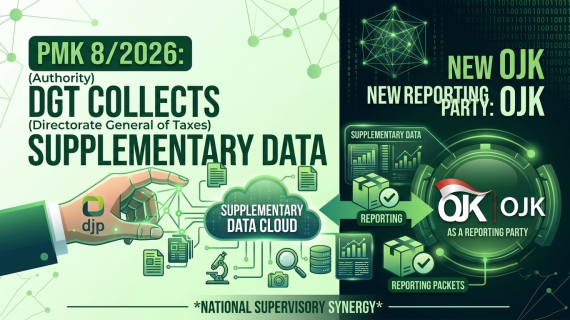
PMK 8/2026 : the authority of the Directorate General of Taxes to collect supplementary data and the addition of OJK as a reporting party
Amends PMK 228/PMK.03/2017 · Enacted 11 February 2026 · In force 27 February 2026 · State Gazette (BNRI) 2026 No. 138
Principal provisions of PMK 8/2026
PMK 8/2026 amends Minister of Finance Regulation Number 228/PMK.03/2017, which regulates the types and details of data and information related to taxation, the parties obliged to submit such data to the Directorate General of Taxes (DGT), and the procedure for its submission. The parties obliged to submit such data and information are grouped as Government Agencies, Institutions, Associations, and Other Parties (ILAP), so that the scope of the data owned by the DGT is determined by the breadth of the ILAP list itself.
The amendment carried out through PMK 8/2026 essentially contains two (2) substantive matters, which can be explained as follows: the authority of the DGT to request additional data on a particular taxpayer where the data already received is not sufficient; and the reconstruction of the Annex listing all ILAP by adding the Financial Services Authority (OJK) as a reporting party. Such an amendment is accompanied by the regulation of supporting mechanisms, namely the notification of data utilisation to the source of the data and the affirmation of the officials authorised to exercise such authority.
This regulation is based on Government Regulation Number 31 of 2012 concerning the Provision and Collection of Data and Information Related to Taxation, and implements the provisions of Article 3 paragraph (4), Article 4 paragraph (1), Article 5 paragraph (2), and Article 7 paragraph (3) of that government regulation. The recitals of PMK 8/2026 explain that the previous regulation had not regulated the notification of data utilisation to the reporting party, had not provided a procedure for the collection of further data where the data received was not sufficient, whereas its list of reporting parties was no longer in accordance with the needs of the DGT at present, so that these three matters became the basis for carrying out the amendment.
Within this regulatory framework, the parties listed as ILAP submit certain types of data to the DGT periodically in accordance with a predetermined schedule. The data and information in question are defined as any information capable of describing the income or wealth of an individual or an entity, including business activity and independent work, so that such data serves as the basis for the DGT in mapping tax potential and carrying out the testing of taxpayer compliance. The amendment carried out through PMK 8/2026 essentially extends the reach of the DGT between those periodic submissions, while also increasing the number of data sources owned by the DGT.
Exhibit 1
Four (4) changes in the body of the regulation and the replacement of the Annex
| Article 1 | Article 5A (new) | Article 5B (new) | Article 5C (new) | Annex A (replaced) |
| Paragraph (6) amended; paragraphs (8) and (9) deleted. The DGT acknowledges data received against the Annex list. | The DGT submits a notification letter of data utilisation to the reporting party. | The authority to request additional data on a particular taxpayer where the data held is not sufficient. | The Article 5A and 5B authority may be delegated to the data Director and the Kanwil heads. | The ILAP list is rebuilt: 52 groups, 105 entities (from 69). OJK is added. |
Substantive changes in the body of the regulation
The new Article 5A obliges the DGT to submit a notification letter of data and information utilisation to the reporting party after such data and information have been received and utilised, read together with the amended Article 1 paragraph (6), whereas the former Article 1 paragraph (8) and paragraph (9) are deleted. The notification letter of data and information utilisation is intended as a form of accountability of the DGT towards the source of the data, so that the institution that has submitted the data and information obtains information that such data has been utilised for taxation purposes, whereas the taxpayer whose data is utilised is not involved and whose consent is not requested in that process.
The operational change is contained in Article 5B. Where a taxpayer’s data and information are not sufficient for the testing of compliance in connection with a particular event, the DGT is granted the authority to request additional data from the head of an ILAP concerning the activity or business, business turnover, income, and/or wealth of that taxpayer. Such a request for additional data is carried out through a request letter that at the minimum contains the data and information requested, the form of its submission, and the reason for the request, whereas the ILAP is obliged to provide the data and information in accordance with the actual condition within a period of no longer than one (1) month from the receipt of the request letter, while continuing to observe the confidentiality provisions over such data.
Article 5B means that the collection of data, which was previously periodic based on a schedule, becomes a collection that can be carried out specifically towards one taxpayer and one event at the time it is needed. This is because the regulation does not determine the triggering event in a limitative manner, so that its scope covers every condition connected to the obligations of the taxpayer at the time the routine reporting leaves a question open, such as: a transaction of a large amount that is not in line with the reported business turnover, or a Tax Return (SPT) that is not in accordance with the data already submitted by a third party. The period of one (1) month is imposed on the ILAP and not on the taxpayer, so that the taxpayer may not be aware of such a request, whereas its indication may be seen from the more directed questions of the DGT.
Exhibit 2
The flow of a supplementary-data request based on Article 5B
| 1 | 2 | 3 | 4 |
| Trigger | Written request | One-month period | Submission |
| The data held is not sufficient to test the taxpayer’s obligation for a particular event. | The DGT writes to the ILAP head, stating the data requested, its form, and the reason. | The ILAP is obliged to answer in accordance with the actual condition within one month of receipt. | The data is submitted to the DGT online or in person; the confidentiality provisions still apply. |
Article 5C affirms the officials authorised to exercise such authority. The authority to submit the notification of data utilisation based on Article 5A and the authority to collect additional data based on Article 5B are essentially owned by the Director General of Taxes, whereas such authority may be delegated by mandate to the high-ranking primary official responsible for tax data and information and to the heads of the Regional Offices of the DGT (Kanwil DJP), so that a request for additional data may originate from an operating unit close to the taxpayer’s case and is not limited to the head office.
The Annex to PMK 228/2017 is replaced in its entirety through PMK 8/2026. The new Annex contains 52 groups of ILAP and 105 reporting entities, whereas the previous Annex contained 69 entities, so that there is a considerable addition of data sources. Among such additions, OJK constitutes the reporting party most influential towards the majority of business actors, because OJK, as the supervisor of the financial services sector, is imposed with the obligation to submit individual debtor data from the Financial Information Service System (SLIK) for holders of credit facilities, together with the debtor financial statements submitted by customers to banks and reporting institutions, which contain the position of assets, liabilities, and equity, business revenue, and the current-year profit or loss, submitted annually no later than the end of April of the following year.
Based on the entirety of the changes explained, the direction of PMK 8/2026 directs tax supervision towards the cross-matching of data among various sources, and not merely towards voluntary disclosure by the taxpayer. This has the implication that the discrepancy between the data reported by the taxpayer to one institution and to another institution can be seen more quickly by the DGT, so that the space for differences in reporting among the parties becomes increasingly narrow.
Exhibit 3
The expansion of reporting parties from 69 to 105 entities
Number of ILAP entities obliged to submit data to the DGT
| PMK 228/2017
listed under the former Annex |
|
||
| PMK 8/2026
52 groups of ILAP |
|
Differences in regulation between PMK 8/2026 and PMK 228/2017
The regulation under PMK 228/2017 is essentially one-directional and periodic, whereby the listed parties submit certain data to the DGT in accordance with the schedule, so that the authority of the DGT over the data is limited only to what is submitted between reporting periods. PMK 8/2026 still maintains such a periodic submission mechanism, whereas it adds the authority to request additional data on a particular taxpayer and expands the data sources owned, while also adding a layer of governance through the notification of data utilisation based on Article 5A, so that the movement of data and information is recorded on both parties.
Exhibit 4
Comparison of regulation between PMK 228/2017 and PMK 8/2026
| Dimension | PMK 228/2017 | PMK 8/2026 |
| Collection model | Periodic reporting on a fixed schedule | Periodic reporting plus event-based supplementary requests |
| Trigger for additional data | Not present in the body of the rule | Data held insufficient for a particular taxpayer event |
| Obligation to answer | Scheduled submission only | Answer per the actual condition within one month of an ad hoc request |
| Feedback to the source | Not regulated | Notification of data utilisation (Article 5A) |
| Holder of the authority | — | DGT; delegable to the data Director and Kanwil heads (Article 5C) |
| Reporting parties | 69 entities listed | 52 groups, 105 entities; OJK added |
| Financial-sector data | Bank data through existing channels | OJK submits SLIK debtor data and bank-lodged financials |
Based on that comparison, all the changes carried out lead towards the same direction, namely the increase of data received by the DGT and the increasing clarity of the basis of authority to request it, whereas the obligations imposed on the taxpayer itself do not undergo any relaxation.
Implications of the changes for the taxpayer
The implication most necessary to be observed by the taxpayer is the consistency of data among various sources. A business actor who submits financial statements with a healthy position to the creditor, while reporting lower figures to the DGT, will find that both versions of the financial statements are at present received by the same party, because OJK forwards the financial statements submitted to the bank, whereas the SPT is already owned by the DGT, so that the difference between the two can be seen without an examination first being carried out.
Exhibit 5
Four (4) principal risks and the response that needs to be carried out
| Issue | What changes | Risk | Response |
| Consistency of data across sources | OJK now submits to the DGT the financial statements the taxpayer lodged with a bank, whereas the SPT is already held. The difference is visible without an examination. | ●
High |
Reconcile the creditor-facing financial statements with the SPT before reporting. |
| Event-based requests (Article 5B) | One event connected to the tax position may become the basis of a specific data request covering business turnover, income, or wealth, answerable within one month. | ◐
Medium–High |
Anticipate faster and more directed supervision; keep supporting documents retrievable. |
| Widening data net | The DGT now draws NPWP-linked data from 105 entities across 52 groups, OJK among them. | ◐
Medium |
Assume most licence and transaction footprints are already visible. |
| Reliance on confidentiality | Collection must observe confidentiality, whereas Article 5A provides notice to the source. Neither gives the taxpayer a means to stop the collection. | ○
Low |
Focus on the accuracy of data at its source rather than on secrecy. |
The subsequent implication is the speed and the specificity of the data request. One event connected to the tax position of the taxpayer may at present become the basis of a specific data request to the third party that owns its record, which is to be answered within a period of one (1) month, so that supervision may be carried out before an official examination and without prior notification to the taxpayer. The confidentiality provisions and the notification of data utilisation based on Article 5A are located on the side of the DGT, so that both do not provide a means for the taxpayer to prevent the collection of data from being carried out.
Based on such implications, the response that needs to be carried out by the taxpayer is to maintain the accuracy of data at its source. The taxpayer needs to carry out the reconciliation of the financial statements submitted to the creditor with the figures reported in the SPT before the reporting is carried out, and not after a request for clarification, so that the supporting documents concerning business turnover, income, and the position of assets need to be kept in order to be obtained at any time. Where a taxpayer’s previous SPT differs from the bank version of the financial statements, the correction of the position through the voluntary channel is considered better than waiting for such a difference to be revealed through the exchange of data.
This regulatory change also affects the manner in which a Request for Explanation of Data and/or Information (SP2DK) or an examination is commenced. The increasingly complete third-party data enables the DGT to compose a request for clarification based on particular figures and not based on open-ended questions, so that the distance between the request for clarification and the assessment becomes increasingly short. Therefore, the taxpayer who has carried out the reconciliation of both sets of data is in a stronger position to provide a response within the period determined.
Entry into force and legal basis of PMK 8/2026
| 11 February 2026
Enacted by the Minister of Finance, Purbaya Yudhi Sadewa |
→ | 27 February 2026
Promulgated & in force · BNRI 2026 No. 138 |
PMK 8/2026 was enacted on 11 February 2026 by the Minister of Finance, Purbaya Yudhi Sadewa, and was promulgated on 27 February 2026 in the State Gazette of the Republic of Indonesia of 2026 Number 138, so that this regulation applies from the date of promulgation. This regulation implements the provisions of Article 3 paragraph (4), Article 4 paragraph (1), Article 5 paragraph (2), and Article 7 paragraph (3) of Government Regulation Number 31 of 2012. Therefore, for the majority of taxpayers, the period most necessary to be observed is the alignment between the financial statements submitted to the creditor and the figures in the SPT before the April reporting, because such financial statements will be submitted by OJK to the DGT.
SOURCE: PMK 8/2026 and Annex (JDIH Kemenkeu); DDTC News; IKPI; ILAP count under PMK 228/2017 per Pajakku.
For further information and taxation queries, please reach to :
Email : info@mul-co.com
WA : +62 82249384918