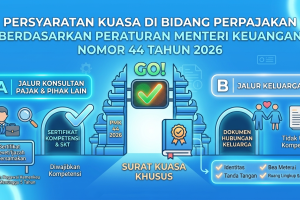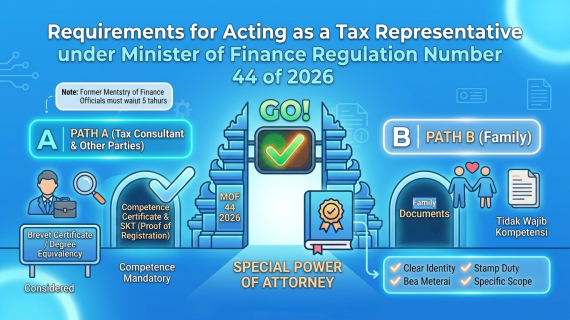
Requirements for Acting as a Tax Representative under Minister of Finance Regulation Number 44 of 2026
Promulgated on 6 July 2026 · revoking Minister of Finance Regulation Number 229/PMK.03/2014
A representative in the field of taxation is juridically regulated once again in Minister of Finance Regulation Number 44 of 2026 concerning the Requirements for Acting as a Representative in the Field of Taxation and the Procedures for Exercising the Rights and Fulfilling the Obligations of a Representative in the Field of Taxation, which was promulgated on 6 July 2026, so that Minister of Finance Regulation Number 229/PMK.03/2014 is declared no longer valid.
That change is not a change of wording. An employee of the taxpayer who until now could be appointed as a representative on the basis of the employment status loses that basis of appointment, whereas a party other than a tax consultant must first prove the competence formally.
Minister of Finance Regulation Number 44 of 2026 implements Article 51 paragraph (2) of Government Regulation Number 50 of 2022 concerning the Procedures for Exercising Rights and Fulfilling Tax Obligations, in which the categories of parties that can be appointed as a representative had been determined, but the particular competence that must be owned by the representative had not been detailed. That detail is what is now provided.
- Parties that can be appointed as a representative
The appointment of a representative is carried out through a Special Power of Attorney (Surat Kuasa Khusus), whether in electronic form through the Taxpayer Portal or in paper form, which contains the identity of the parties, the scope of the power of attorney and its validity period, and which fulfils the stamp duty requirements.
The parties that can be appointed as a representative consist of three (3) categories, which can be further explained as follows:
- a tax consultant, being a person who owns a tax consultant licence issued by the Minister of Finance and that licence remains valid;
- another party (pihak lain), being a person other than a tax consultant and a family member who has obtained a Registration Certificate (Surat Keterangan Terdaftar or SKT); and
- a family member of the taxpayer itself.
Article 1 number 5 of Minister of Finance Regulation Number 44 of 2026 explains that “a family member is a husband, a wife, or a person who has a blood or marital relationship up to the second degree with the taxpayer” (free translation).
That family relationship must be proven by supporting documents.
A particular competence in the field of taxation means that the party appointed as a representative owns an adequate understanding of the laws and regulations in the field of taxation, as determined in Article 3 paragraph (1) of Minister of Finance Regulation Number 44 of 2026. That competence is evidenced differently in each category, in which for a tax consultant the competence is evidenced by a tax consultant licence, whereas for another party the competence is evidenced by a Registration Certificate.
A family member is excepted from that testing.
A tax consultant and another party, based on Article 6 of Minister of Finance Regulation Number 44 of 2026, must be registered in the administration system of the Directorate General of Taxes, so that a tax consultant or another party who is being subjected to a suspension or revocation of the tax consultant licence or of the Registration Certificate cannot be appointed as a representative.
Another party who comes from a former employee of the Ministry of Finance, whether a retired Civil Servant, a Civil Servant who ceased before reaching the retirement age limit, or a former Government Employee with a Work Agreement, then the appointment as a representative can only be carried out after passing a cooling-off period of five (5) years and on the condition of never having received a severe disciplinary sanction relating to abuse of authority, gratification, illegal levies, conflict of interest, or other ethical violations.
Parties that can hold a Special Power of Attorney
|
Figure 1. The three (3) categories of representative and the evidence of competence required.
- Differences from the previous regulation
Minister of Finance Regulation Number 229/PMK.03/2014 determined that a power of attorney could only be granted to a tax consultant and to an employee of the taxpayer.
The difference between the two regulations formally appears in the increase in the categories of parties that can be appointed, but the actual difference lies in the requirement of proof. The status of being an employee, which in practice was until now considered as sufficient to represent the taxpayer, is replaced by the Registration Certificate as evidence of competence that can be tested and can be traced. This has the implication that the control over who is entitled to speak for the taxpayer moves from the taxpayer to the state.
| PMK 229/PMK.03/2014 | PMK 44 of 2026 | |
| Parties that can be appointed | A tax consultant and an employee of the taxpayer. | A tax consultant, another party owning an SKT, and a family member. |
| Evidence of competence | The status of being an employee, without express testing of competence. | A tax consultant licence for a tax consultant; a Registration Certificate for another party. |
| Family members | Not yet recognised as a separate category. | Can be appointed up to the second degree, without a competence requirement. |
| Transfer of authority | Not yet expressly regulated. | Prohibited. One Special Power of Attorney for one representative, limited to particular rights or obligations. |
| Former Ministry of Finance staff | No cooling-off period regulated. | A cooling-off period of five (5) years and a good track record. |
| Electronic exercise | Drafted before the Taxpayer Portal was applied. | Requires an access approval through the Taxpayer Portal. |
Table I. Comparison of Minister of Finance Regulation Number 229/PMK.03/2014 with Minister of Finance Regulation Number 44 of 2026.
Testing the eligibility of the party to be appointed
▼
|
Figure 2. The flow for testing the eligibility of the party to be appointed as a representative.
- Transitional provisions and the 31 December 2026 deadline
A Special Power of Attorney that was made based on the previous provisions remains valid until the exercise of the rights or the fulfilment of the tax obligations that were delegated has been completed. An ongoing appointment of a representative therefore does not become void on 6 July 2026.
Article 16 paragraph (1) of Minister of Finance Regulation Number 44 of 2026 determines that a person other than a tax consultant can still be appointed as a representative until 31 December 2026 if that person owns a tax brevet certificate or a formal educational diploma in the field of taxation of at least Diploma III (D-III) from an A-accredited higher education institution, whereas Article 16 paragraph (2) requires that a Special Power of Attorney made on the basis of that alternative requirement be made in paper form, attached with a copy of the evidence of competence and submitted to the Tax Service Office.
Dates that must be observed
|
Figure 3. The date of entry into force and the deadline of the transitional provision.
The procedures for obtaining a tax consultant licence and a Registration Certificate are carried out in accordance with the ministerial regulation governing tax consultants and other parties acting as a representative, so that a taxpayer who plans to appoint another party in 2027 needs to observe the issuance of that implementing regulation, whereas up to the preparation of this summary that implementing regulation had not been issued.
- Matters that must be observed by the taxpayer
A taxpayer who is going to appoint a representative based on Minister of Finance Regulation Number 44 of 2026, then needs to observe a number of matters which can be further explained as follows:
- the responsibility for the exercise of the rights and the fulfilment of the tax obligations remains with the taxpayer itself, so that the appointment of a representative does not transfer that responsibility to the recipient of the power of attorney;
- one Special Power of Attorney is valid for one representative only and can only be used for the exercise of the rights or the fulfilment of the particular tax obligations stated in that power of attorney, whereas the transfer of the authority to another party is prohibited;
- the granting of a power of attorney for the electronic exercise of rights and fulfilment of tax obligations must be accompanied by an access approval granted through the Taxpayer Portal;
- the validity of the tax consultant licence or of the Registration Certificate must be ascertained before the Special Power of Attorney is signed, so that the risk of the appointment becoming void can be avoided;
- the revocation of a power of attorney is carried out through a letter of revocation which takes effect from the time it is received by the Directorate General of Taxes and does not apply retroactively; and
- the granting of a power of attorney ends if the validity period of the Special Power of Attorney expires, it is revoked by the taxpayer, the tax consultant licence or the Registration Certificate is suspended or revoked, or the recipient of the power of attorney is criminally convicted, in which the Directorate General of Taxes issues a notification electronically to the taxpayer and to the representative concerned.
Therefore, a taxpayer who until now appoints an employee as a representative needs to carry out an adjustment before 31 December 2026, whether by transferring that work to a licensed tax consultant, by processing a Registration Certificate for the employee concerned, or by using the transitional route based on a brevet certificate or a Diploma III diploma while the year 2026 is still running.
That deadline is the nearest benchmark.
For further information and taxation queries, please reach to :
Email : info@mul-co.com
WA : +62 82249384918