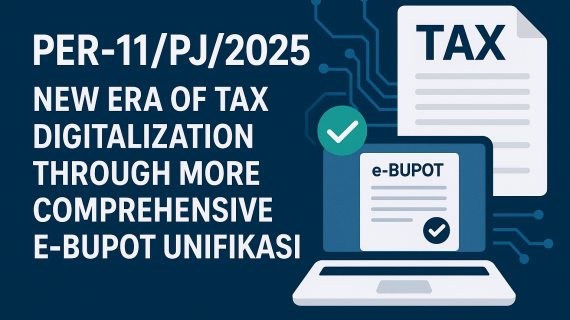
The world of Indonesian taxation is adapting again with the enactment of the Director General of Taxes Regulation Number PER-11/PJ/2025 concerning Provisions for Reporting Income Tax, Value Added Tax, Sales Tax on Luxury Goods, and Stamp Duty in the Framework of Implementing the Core Tax Administration System, hereinafter referred to as “PER-11”. This regulation marks a more comprehensive digitization of tax administration, particularly related to the withholding and collection of Income Tax.
In PER-11, 10 chapters are discussed, from general provisions to closing, one of which is chapter 2, which discusses the form and procedure for making Unification Withholding and Collection Evidence and the form, content, and procedure for filling out the Unification Income Tax Periodic Tax Return. The essence of the changes to the e-Bupot Unifikasi is to simplify and integrate the process of reporting withholding and collecting income tax.
The fundamental difference between PER-11 and previous regulations, especially PER-24/PJ/2021, lies in the scope expansion and refinement of the e-Bupot Unifikasi. Previously, the creation of Unifikasi withholding slip evidence and reporting was carried out through the DGT online platform on the e-Bupot Unifikasi menu. Now, the system for creating Unifikasi withholding slips is separate from reporting, with creation carried out in the Coretax system through the Unifikasi Withholding and Collection Slip (BPPU) menu, while reporting is carried out through the Withholding tax (SPT PPh Unifikasi) menu. Additionally, although it previously only covered certain types of income tax reporting, PER-11 now integrates more types of income tax withholding and collection into a comprehensive platform.
Income tax that is now more broadly accommodated in BPPU PER-11 includes:
- Article 4 paragraph (2) Income Tax: Final Income Tax imposed on certain income, such as land/building rent, interest on deposits, lottery prizes, and others.
- Article 15 Income Tax: Income tax on certain income calculated with a special calculation norm, such as income from domestic shipping, domestic aviation, and foreign insurance companies.
- Article 22 Income Tax: Income tax levied by government treasurers and certain entities in connection with payments for the delivery of goods, imports, or certain business activities.
- Article 23 Income Tax: Income tax withheld on income in the form of dividends, interest, royalties, rent, and other income in connection with the use of assets, as well as service fees.
- Article 26 Income Tax: Income tax on income received or earned by foreign taxpayers other than permanent establishment in Indonesia.
- Several other income taxes that have not previously been comprehensively accommodated in one system.
This aims to create a more efficient and integrated reporting ecosystem, reducing administrative complexity for taxpayers and improving data accuracy for the Directorate General of Taxes (DGT).
It’s important to note that there is a difference in the payment deadlines for periodic tax returns. Previously, these were regulated under Minister of Finance Regulation Number 242 of 2014 (“PMK 242“), which has now been Amendment by Minister of Finance Regulation Number 81 of 2024 (“PMK 81“). Under PMK 242, the deadline for depositing withheld/collected income tax was no later than the 10th of the following month, the deadline for self-paid income tax was no later than the 15th of the following month, and the deadline for filing periodic tax returns was no later than the 20th of the following month. Under the new PMK 81, the deadline for depositing all types of income tax has been standardized to no later than the 15th of the following month, while the deadline for filing periodic tax returns remains the 20th of the following month.
In addition to the differences from the scope of the type of income tax that are deducted/collected and the time limit for the deposit, there are other more significant differences in Unification Periodic Income Tax Return before Per-11 and after Per-11 is enforced, the following are the differences:
| Before PER-11 | After PER-11 |
| Unifikasi Periodic Income Tax Return
• Main Form • List of Self-Assessed Income Tax Payments • List of Objects for Withholding/Collecting Income Tax from Other Parties • List of Evidence of Withholding/Collection Unifikasi along with List of Tax Payment Slip, State Receipt, Evidence of Overbooking of Article 4 paragraph (2) Income Tax, Article 15 Income Tax, Article 22 Income Tax, Article 23 Income Tax and/or Article 26 Income Tax. Withholding Tax Slip • Proof of Withholding and/or Collection of Unification Income Tax in Standard Format • Documents Equivalent to Proof of Withholding/Collection Unification |
Unifikasi Periodic Income Tax Return
• Main form • List I – List of BPPU Standard Format • List II – List of self-paid/self-deposited and paid income tax combined • Attachment I – List of documents that are equivalent to BPPU Withholding Tax Slip • Proof of Withholding and/or Collection of Unification Income Tax in Standard Format • Documents Equivalent to Evidence of Withholding and/or Collection Unification |
Implications and Potential Risks for Taxpayers
The transition to the more integrated reporting system requires taxpayers to understand thoroughly not only the technical mechanisms but also their tax and administrative implications. Although bringing many benefits, this change is also not without potential risk for taxpayers.
One of the biggest potential risks is the potential for non-compliance due to a lack of understanding of changes in rules. This includes:
- Types of transactions that must be unified: Taxpayers need to ensure that all relevant PPh withholding/collection transactions have been recorded in the BPPU menu in the e-Bupot module in accordance with PER-11.
- Reporting deadline: Late reporting, even if it is only a day, may trigger administrative penalties. Taxpayers should understand the new reporting schedule and strictly adhere to it.
- Correction and rectification mechanism: Data input errors are common. Taxpayers should understand the correct procedure to make corrections or amendments to the withholding slip or periodic tax return that has been filed.
Data input errors, late reporting, or discrepancies between the reported data and the Taxpayer’s financial records can trigger administrative sanctions in the form of administrative fines, as stipulated in the general provisions of taxation law. These fines can vary depending on the type of violation and the amount, so it is important for taxpayers to be careful and accurate in their reporting.
In addition, wider integration also means increased potential exposure of transaction data to the Directorate General of Taxes (DGT). This demands higher data accuracy. Any discrepancies between the reported data and the DGT’s internal data or data from third parties may trigger a clarification or audit request. Therefore, taxpayers must ensure that their internal systems are capable of producing data that is accurate and in line with the standards set by PER-11.
For further information and taxation queries, please reach to :
Email : info@mul-co.com
WA : +62 82249384918